Surfing After 30: How to Progress Faster When You Can't Surf Every Day
You're 34, you get to surf maybe 25 days a year, and you're stuck in the whitewater. Here's how to actually progress when the water time isn't there.
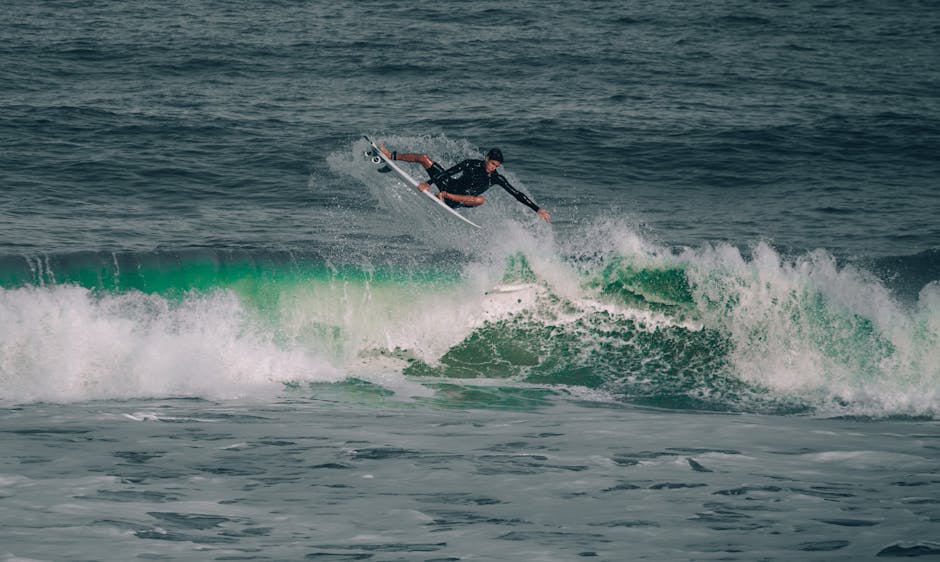
The median American man who picks up surfing at 30 will never paddle out at a real point break. Not because he can't — because his progression model is broken. He surfs twice a month when he's on holiday, paddles out on a board that's too short, and wonders why he's still pearling on steep waves after four years.
Surfing is one of those disciplines where the physics are unforgiving. You can't fake it. The wave will find any weakness in your paddling, your positioning, or your pop-up. Which means the path to progression after 30 is about building capacities on land that compound the moments you actually have in the water.
Your Biggest Enemy Is Not the Wave
It's your shoulders. Specifically, your shoulder endurance and your paddling economy. The difference between someone who catches ten waves in a two-hour session and someone who catches two isn't balance or courage — it's the cardiovascular system that delivers oxygen to the arms while they do 300 paddle strokes per hour.
Most men in this demographic have trained upper body for pulling and pushing (pull-ups, bench press) but not for sustained rotational endurance. That's why your shoulders burn 40 minutes into a session and you sit on the shoulder drinking water while everyone else is catching.
The Dryland Program
Three sessions a week, 40-50 minutes each:
- Ski erg, 4 × 8 minutes at conversational pace, 1 minute rest — builds paddle-specific endurance
- Weighted carries (suitcase, farmer, overhead), 4 × 40 metres — trunk stability transfers directly to board stability
- Pop-up practice on a balance board, 5 × 1 minute — your pop-up is a motor pattern, not a strength problem
- One long easy swim or open-water paddle per week, 25-40 minutes — aerobic base for duck diving and paddle-outs
This is the opposite of "surf workout" TikTok content. Those videos are full of box jumps and agility drills that look athletic. Real progression comes from boring aerobic volume in shoulder-dominant patterns.
Session Focus — Why Most People Waste Their Water Time
The typical session pattern: you paddle out, catch three whitewater rides, pop up inconsistently, have two good rides and six bad ones, come in. Three hours later you got 15-20 actual wave rides, of which you can learn from maybe two.
Here's a better system. Pick one focus per session. Just one.
Session focus 1: pop-ups. Today, you don't care about which waves you catch. You care about clean pop-ups. Go to a break with mellow whitewater, catch 40 waves, and pop up on each one with perfect hand placement and trajectory. Film yourself from the shore. You'll be worse at wave selection this session and better at pop-ups for the next five years.
Session focus 2: positioning. Today, you surf only waves you catch with no paddle correction. That means you line up perfectly or you don't go. You'll catch fewer waves, you'll improve your reading of the break, and you'll stop drifting inside where all the beginners are.
Session focus 3: left or right, not both. Pick a direction. Take only waves going that way. If you're weaker on your backhand (as most men are), go backhand-only for an entire session.
Board Selection — The Trap
You don't need the board you want. You need the board that will accelerate your progression. Most 30-something men learning to surf buy boards that are 2 litres under what they should be — somebody told them a shorter board was more fun.
Here's the volume guide that actually works. Take your body weight in kilograms, multiply by 0.6. That's the minimum board volume in litres you should be on during your first 200 sessions. An 85 kg rider needs at least 51 litres. That's probably a 7'0" mid-length or a high-volume 6'6" groveller, not the 5'11" Channel Islands thruster your mate says is "sick."
Brands worth considering for progression: Torq, NSP, and JS Industries all make mid-volume boards that hold up. For a first serious shortboard after a soft-top phase, the Torq TEC Go-Kumi at 7'0" or 6'8" is a workhorse. For a progression to performance, something like a JS Monsta Box or a Pyzel Phantom in a higher-volume spec keeps you catching waves.
Where You Surf Matters More Than Most Admit
If you're learning at a close-out beach break with a shifting sandbar, you will progress slower than someone who's learning at a consistent point break, even with the same number of hours. Point breaks — San Onofre in California, Noosa in Queensland, Pavones in Costa Rica, Chicama in Peru — offer long, forgiving rides where you have time to stand up, find your feet, and actually ride the wave.
A two-week trip to a point break at 35 years old can compress a year of local beach-break learning. This is worth budgeting for. You'll come back with a different surfing body memory that persists for months.
The Wetsuit Question
Cold water kills your learning. If you're in water under 15°C and shivering 90 minutes into a session, your neuromuscular system is done. Buy the warmer wetsuit. A Patagonia R2 or Rip Curl E7 at 3/2mm for summer, 4/3mm for autumn, and 5/4mm hooded for winter will add 45 minutes to every session you do. That's worth more than any technique tweak.
The Ten-Year Bet
Surfing rewards patience. Men who started at 30 and kept at it carefully are surfing better at 45 than most who started at 20 and got sloppy. The body stays capable well into the fifties for this sport. The limiting factor is not age — it's the quality of your inputs.
Twenty-five days of water per year, done well with targeted focus, plus structured dryland work, will take you from whitewater to catching proper waves in three seasons. Then you'll be the guy on holiday who's actually surfing, not paddling.