Wingfoiling: The New Water Sport Worth Learning
Wingfoiling combines hydrofoil flight with hand-held wing power. Silent, fast, and growing fast.
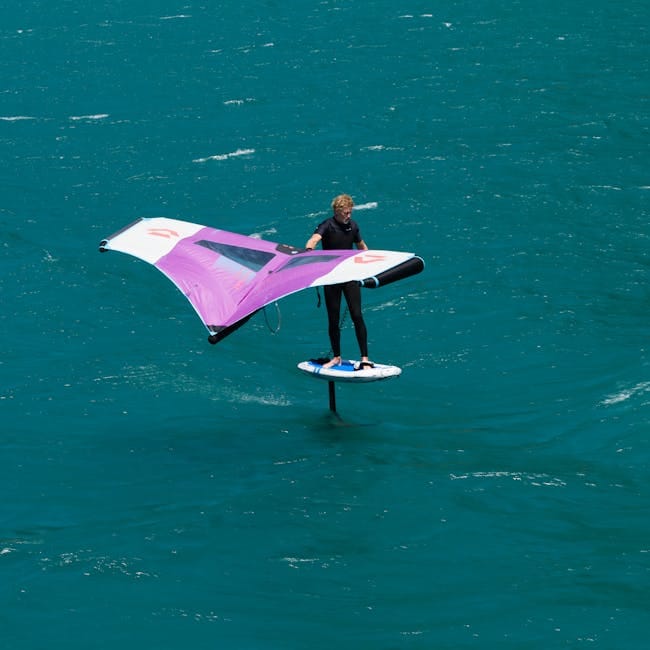
Wingfoiling appeared in 2019 and has become one of the fastest-growing water sports. It combines stand-up paddle-style riding with wind power - you hold a hand-held inflatable wing to catch wind, while balancing on a hydrofoil board. The result: you fly above the water at 15-30 knots, silently, often solo. No sails, no lines, no mast.
I started wingfoiling two years ago after years of kitesurfing. The learning curve surprised me - both steeper and shallower than expected. Some elements are easier than kiteboarding, others are harder. Here's what wingfoiling actually is and whether you should learn it.
How Wingfoiling Works
The components: a board with a hydrofoil (underwater wing attached to the board), a hand-held inflatable wing that catches wind, and a harness (optional but common).
How it moves: the wind pushes the wing. The wing tension is transferred through your body and board to the water. The board, pushed by the wing, travels forward. Once at speed, the hydrofoil lifts the board out of the water. You fly 30-60cm above the water surface, silent, on a single foil.
Launch: you start in the water with the wing depowered (wing folded or with no pressure). You get on the board in a kneeling position. You catch wind on the wing. You start moving. You stand up. At 5-8 knots wind you can pump the board up onto the foil.
Key differences from other wind sports
- No lines or masts (vs kitesurfing)
- Wing is silent in hand (vs windsurf rig)
- Foiling = minimal contact with water (vs SUP or surf)
- Uses moderate wind (12-30 knots typical)
- Low impact on body
Learning Curve
First sessions: on a large, stable board without foiling. Practice holding the wing, moving it through power positions, and controlling power.
Next sessions: smaller board, still no foiling. Build endurance with the wing, learn to edge, practice carving turns.
First foiling: kneeling start on foil-capable board. Pump board up to foil position. Begin flying.
Standing foiling: rise from knees to feet while foiling. Hardest moment in the learning curve.
Real riding: extended foil flights, carving, riding upwind.
Typical progression timeline
- First 5 sessions: in water, not foiling yet
- Sessions 5-15: foiling on knees, short flights
- Sessions 15-30: standing foiling, extended flights
- Sessions 30+: tricks, carves, advanced moves
Equipment Selection
Board: your first board should be 130-150 liters, 6-7 ft long, with a foil mount. Inflatable (more durable) or hardboard (better performance). Brands: Naish, Armstrong, North, F-One, Duotone. $800-2,000.
Foil: the hydrofoil under the board. Larger front wing = easier to ride, slower. Smaller wing = harder to ride, faster. First foil should be 1,500-2,000 cm² front wing. $600-1,500.
Wing: inflatable wing you hold. Sizes 3-7m². Smaller = less power but more control. Start with 5-6m² for most conditions. $800-1,400.
Harness: loop around your waist that attaches to the wing. Allows hands-free riding in sustained wind. $80-200.
Wetsuit: depends on water. Warm water: shortie or rashguard. Cold water: 5/4 full suit.
Starter wingfoil kit
- Board: $1,200 (mid-range inflatable)
- Foil: $900 (freeride foil)
- Wing: $1,000 (5m²)
- Harness: $120
- Pump + accessories: $100
- Total starter: $3,320
Wind and Water Conditions
Minimum wind: 10-12 knots. Less and the wing doesn't generate power to lift the foil.
Ideal wind: 15-25 knots. Consistent enough to maintain foiling, not so strong it's dangerous.
Maximum practical wind: 35+ knots. Beyond this, wind becomes dangerous and wing handling becomes difficult.
Water: flat water easier to learn. Choppy water harder but more realistic. Waves provide bumps you ride, but also disruption.
Temperature: water temperature dictates wetsuit. Wingfoiling works in any season with proper wetsuit.
Safety Considerations
Rip currents: wingfoilers can be pulled away from shore quickly by wind and current. Check conditions before launching.
Collisions: boats, jet skis, other water users. Wingfoilers are silent and hard to hear. Wear bright gear.
Fall patterns: from foiling height (30-60cm above water), falls can be jarring. Wear impact vest for first sessions. Don't fall directly onto the foil - it can cause serious injury.
Self-rescue: know how to get back to shore without wing power. If wind dies, you might need to paddle-kick with the board underneath you.
Never wingfoil alone in risky conditions. A partner can help if you crash or have equipment failure.
Comparison to Related Sports
Kitesurfing: more complex equipment (kite, lines), larger learning area needed, more dangerous if wind drops. Wingfoiling simpler to learn and safer.
Windsurfing: mast and sail on board, more traditional. Wingfoiling easier to learn but less diverse tricks.
SUP foiling: no wind, uses paddle. Wingfoiling uses wind, more sustained, more distance covered.
Foiling in general: wingfoiling is the entry point for foil sports. Once comfortable, pilots often transition to kite foiling, wing foiling with surfboards, or prone foiling.
Advanced Techniques
Tacks: changing direction on the foil. Involves rotating the wing through the wind window while maintaining balance on the foil. Takes 20+ sessions to master.
Carves: turning on the foil without tacking. Requires weight shift and foil angle control.
Pop-ups: brief aerial movements on the foil. Light launches where the foil briefly leaves water.
Upwind riding: riding directly into the wind at a 45-90 degree angle. Requires good foil technique and wing positioning.
Downwind surfing: riding waves while wingfoiling. The wing supplements wave energy. Advanced riders can foil on waves.
Why Learn Wingfoiling
It's a new sport. No established community rituals or hierarchy. Everyone's learning together.
Low environmental impact. No motor. Minimal splash. Silent.
Flexible wind range. Works in 12-35 knot conditions, which covers most days at most locations.
Physical demands moderate. Less upper body than windsurfing, less full-body than kitesurfing. Good for 30-60 year olds looking for wind sport.
Travel-friendly. Inflatable wings and boards pack small. Foils pack medium. Entire kit fits in a large duffel.
The Catch
Cost: $3,000+ entry barrier. Not a cheap sport to start.
Learning curve: 20+ sessions before you're truly foiling consistently. Not instant gratification.
Location: need water with room to ride. Small lakes don't work.
Rapid equipment evolution: the "best" wing from 2022 is mediocre in 2026. You'll upgrade regularly.
Wingfoiling is worth learning. The riding feel is unique - silent flight above the water. The progression rewards consistent practice. The sport is still developing, so early adopters are shaping what it becomes. If you have the interest and the money, wingfoiling is one of the most exciting new water sports in decades.