Speedflying in 2026: The Fastest Way Down a Mountain, and Why So Many Pilots Are Buying Wings They Aren't Ready For
A speed wing gets you off a ridge and moving at 50 mph in under four seconds — no altitude to fix a mistake if something goes wrong. Here's what the sport actually demands before you buy one.
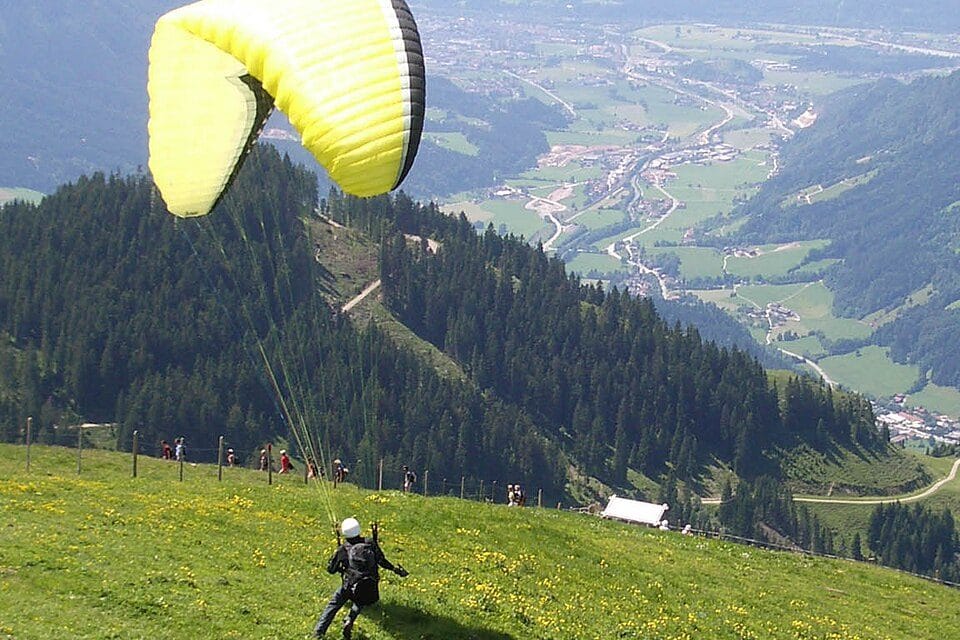
A ridge above Chamonix, first light, and a pilot is running downhill with a wing barely a third the size of a normal paraglider clipped to his harness. Three strides later the fabric is loaded, four strides after that his feet leave the snow, and within four seconds he's doing close to 50 mph along the fall line of the mountain, canopy skimming ten feet over the rocks. That's speedflying — sometimes called speed riding when it's done on skis — and it's the fastest-growing way men are getting off alpine terrain right now, for the simple reason that it delivers the sensation people chase in wingsuiting and BASE jumping without needing an aircraft, a cliff, or a $10,000 rig.
What Actually Separates Speedflying From Paragliding
The wing is the whole story. A recreational paraglider runs 22 to 30 square meters of canopy and is built to stay airborne, catch thermals, and forgive a clumsy landing. A speed wing runs 8 to 18 square meters — Ozone's Freeride and Mojo lines, Gin's Range, Supair's Speed² all sit in that window — and it's built to do the opposite: stay low, stay fast, and get you back on the ground in under a minute. Wing loading on a speed wing typically runs double what a paragliding pilot is used to, which means the canopy reacts to input almost instantly and punishes hesitation just as fast. Glide ratios sit around 3:1 to 5:1 depending on wing size and pilot weight, well below a paraglider's 8:1 or 9:1, and that's deliberate — you're not trying to float, you're trying to carve terrain the way a skier does, just six feet off the snow instead of on it. Pilots who've flown both disciplines describe the transition as closer to switching from a cruiser bike to a downhill mountain bike than any kind of gradual upgrade, because nothing about the muscle memory carries over cleanly. Even the launch is different: a paraglider inflates gently over several seconds, while a loaded speed wing can be overhead and pulling within a stride and a half, which is exactly why instructors won't hand a novice a small one.
A new speed wing runs $2,500 to $4,000 depending on brand and size, and a dedicated harness — lighter and lower-profile than a paragliding harness, since you're not sitting in it for a two-hour thermal flight — adds another $300 to $600. Buy your first wing too big and you'll never get it loaded enough to feel the sport's actual appeal; buy it too small before you've logged real hours and you'll be flying something that reacts faster than you can. That second mistake is the one that puts people in the trees.
The Path In, and Where the Shortcuts Get People Hurt
Every credible speedflying school, in the US or the Alps, requires a paragliding foundation first — specifically a USHPA P2 novice rating, which means ground school plus a minimum of roughly 15 to 20 supervised flights before an instructor signs off. This isn't bureaucratic gatekeeping any more than the 200-jump rule is in wingsuiting. A speedflying wing collapses and recovers completely differently from a full-size paraglider, and the only way to develop the reflexes for managing that at low altitude is to have already built them at a safe altitude, on a wing that gives you time to think. Skip that step and buy a small wing straight out of a two-day intro course, and you're flying gear that outpaces your instincts by a wide margin.
Log your first 30 to 40 flights on a wing sized conservatively for your body weight — most instructors put that at the larger end of the 14 to 16 square meter range for an average adult male — before even thinking about sizing down. Don't chase the smaller, faster wings early. That's the single worst-value upgrade in the sport, because the performance gain is marginal compared to what a novice loses in margin for error, and every speedflying instructor worth listening to will tell you the same thing without hedging.
Gear Progression That Actually Makes Sense
- First wing: 14–16m², sized to the larger end of your weight range, from Ozone, Gin, or Supair
- Reserve parachute rated for your all-up weight — non-negotiable, and several US schools won't let you fly without one
- A low-profile harness built for speedflying, not a repurposed paragliding harness
- Helmet rated for the impact profile of low-altitude flying, which is a different standard than a standard climbing or ski helmet
- Only after 30+ flights and an instructor sign-off: a smaller wing in the 10–13m² range, and even then, sized up rather than down if you're between two numbers
Where It's Legal in the US, and Where It Isn't
Chamonix remains the sport's spiritual home — it's where Antoine Montant and a handful of other paragliding pilots effectively invented speedriding in the mid-2000s by strapping small wings to their ski setups on the Aiguille du Midi's north side, and French resorts have generally tolerated it since. The US picture is messier. Jackson Hole Mountain Resort, along with most major Utah and Colorado resorts, explicitly bans unauthorized flying on resort terrain, largely because standard resort liability insurance doesn't cover it and ski patrol has no protocol for a mid-mountain wing collapse. What you'll find instead is a patchwork of backcountry scenes: the Wasatch backcountry near Salt Lake City, terrain around Telluride, and pockets of the Tetons outside resort boundaries where local pilots fly with tacit acceptance but no official sanction.
If you're serious about learning, book a course in Chamonix or at one of the handful of certified schools in the French and Swiss Alps rather than trying to piece together instruction from YouTube and a local paragliding club — the terrain there is purpose-built for progression, with staged slopes that let instructors put you on appropriately sized launch zones as your skill grows. That's not available at most US locations, where you're often choosing between terrain that's too flat to be useful or terrain that's unforgivingly steep for a beginner.
Why the Injury Numbers Keep Climbing as the Sport Gets Popular
There is no altitude to fix a mistake.
That's the entire risk profile in one line, and it's why French mountain rescue services and the national paragliding federation (FFVL) have flagged rising speedflying incidents as participation has grown over the past decade. A paragliding collapse at 2,000 feet gives a pilot time to diagnose the problem, correct it, and even throw a reserve if needed. A speedflying collapse typically happens at 100 to 300 feet above the terrain, sometimes lower, and at that height there's no time for any of that sequence — you're already committed to whatever the wing does next. This isn't paragliding's accident profile transplanted onto a smaller wing. It's closer to motocross or downhill mountain biking: high-frequency, low-consequence-until-it-isn't, where most flights end fine and the ones that don't end badly fast. Wind gusts that a full-size paraglider would shrug off at altitude can collapse a speed wing's leading edge at exactly the height where recovery isn't mathematically possible, and that single fact explains why so much of the sport's safety culture is built around launch-site judgment rather than in-flight technique. Pick the wrong afternoon, not the wrong maneuver, and that's usually where it goes wrong.
None of that means the sport is reckless by nature — plenty of experienced speedflyers log hundreds of flights a season without incident, and the terrain-carving feeling the sport is built around is real and, by every account from people who've done both, more visceral than paragliding and more accessible than wingsuiting. The catch is that the margin between "experienced pilot having a great season" and "pilot who bought a small wing after one intro course" is almost invisible from the outside, and gear shops selling directly to enthusiastic beginners don't always ask the right questions before ringing up a sale.
What to Actually Do If You're Considering This
Start with paragliding, not speedflying — get your P2 rating through a USHPA-affiliated school, put in your 15 to 20 flights, and let an instructor tell you honestly whether your reflexes and decision-making are ready for a wing that reacts in a fraction of a second rather than several. Once you're there, book Chamonix over a weekend course closer to home if you can manage the trip; the terrain and instructor density make the difference between a real progression and a rushed one. And when you do buy your first wing, size up, not down — the version of you that wants a smaller, twitchier canopy will still be there in thirty flights, and by then you'll actually have the hands to fly it.