Hard Enduro in 2026: The Rock-Garden Technique and Gear Setup That Separate Finishers From Quitters at Red Bull Romaniacs
Rock gardens, gearing, tyre choices and the pacing lessons from Red Bull Romaniacs 2026 — what actually separates hard enduro finishers from the riders who quit in the first hour.
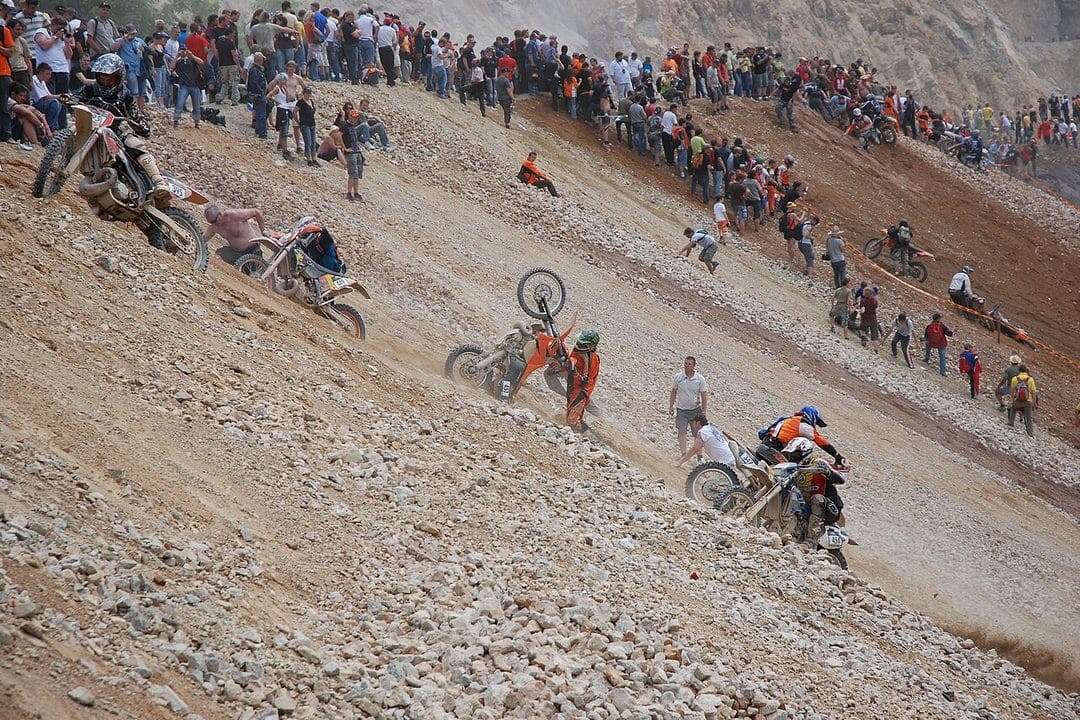
Your front wheel is wedged between two boulders, the engine's stalled, and your forearms have gone past the point where you can trust them to hold a clutch lever properly. That's the moment hard enduro actually starts — not the start line, not the first few kilometres of forest track, but the second the terrain stops being rideable in any conventional sense and becomes something you have to solve, one metre at a time, on a machine that weighs more than you do. Somewhere in Sibiu, Romania, several hundred riders are living through exactly that this week: Red Bull Romaniacs 2026, the 23rd edition of the event, runs from 28 July to 1 August under the theme "Unstoppable," and it remains the most international hard enduro competition anywhere, with entrants arriving from 58 countries.
What Hard Enduro Actually Demands That Motocross and Trail Riding Don't
Ordinary enduro rewards fitness and navigation. Motocross rewards raw speed and jump technique. Hard enduro rewards neither of those things nearly as much as it rewards patience, balance and the willingness to go slower than feels natural. The terrain is the whole point — organisers at events like Romaniacs and its Austrian cousin, the Erzbergrodeo, deliberately build in near-vertical climbs, boulder fields, log crossings and water obstacles specifically because a fast, aggressive rider will fail them, while a smooth, patient one who reads the ground three feet ahead will crawl through. You're not racing the clock in the way you would on a motocross track. You're racing your own ability to stay calm when the bike is doing something you didn't plan for.
This is why so many capable, race-fit riders show up to their first hard enduro event and get spat out within the opening hour. They arrive with motocross reflexes — stand up, gas it, commit — and those reflexes are precisely wrong for a rock garden. The muscle memory that wins a moto start line actively works against you the moment the ground turns to broken granite, because every instinct built on a motocross track says accelerate through a problem rather than slow down and read it. Buy the auto-clutch conversion before you buy anything else if you're serious about this discipline; a Rekluse or similar (roughly £550–£750 fitted in the UK) removes one entire category of stalls and lets you focus every bit of concentration on where the front wheel is going, which matters more here than horsepower ever will. It's not a subtle difference either — riders who make the switch typically describe their first rock garden afterwards as boring, in the specific way that competence makes hard things boring. That's the goal, not a contradiction: hard enduro rewards the rider who's engineered the panic out of the equation before the flag even drops.
The Rock-Garden Skill Cody Webb Calls "Crawling Like a Caterpillar"
Speed kills momentum here — patience doesn't.
Cody Webb, a three-time AMA EnduroCross champion and SuperEnduro World Champion who came up through mototrials before switching disciplines, teaches rock gardens as a single repeatable pattern rather than a series of separate obstacles. Stand on the pegs. Keep the front end light so the wheel can float up and over instead of stabbing into every gap. Feather the clutch to keep the rear wheel turning just fast enough to maintain drive without spinning it into the rocks. Let the bike's own geometry do the climbing while you steer with your body weight rather than the handlebar. Done properly, it looks less like riding and more like a machine slowly, deliberately crawling — which is exactly the image Webb uses when he coaches it.
What that technique doesn't fix is fitness, and this is where a lot of riders underestimate the discipline. Muscling a 110kg enduro bike through a boulder field for six hours a day, four days running, the way this year's Romaniacs schedule demands, empties your arms and shoulders long before it empties your legs. Grip strength fails first. When it does, the caterpillar technique is the only thing that still works, because it asks the bike to do the climbing instead of your arms.
Gear It Down Before You Show Up
The single cheapest, least glamorous upgrade a hard enduro rider can make is also one of the most effective: dropping the final-drive gearing. A larger rear sprocket — two or three teeth up from standard — gives you far finer control at walking pace and takes real heat load off the clutch, because you're no longer slipping it constantly just to crawl over an obstacle at 3mph. Riders who skip this step tend to cook their clutch plates by lunchtime on the first technical stage.
Gearing down isn't free, though — drop the final drive too far and the same bike that crawls beautifully through rocks becomes a liability on the road-transfer sections between special stages, screaming through the gearbox at motorway speeds it was never meant to hold. Serious competitors get around this the unglamorous way: they carry two rear sprockets and swap between them depending on whether the next section is technical or a transfer, a five-minute job with the wheel already off for a tyre check anyway.
Tyres and Mousses: The Traction Decision Nobody Talks About Enough
Traction is everything in hard enduro, more than in almost any other form of motorcycling, and the choice between an inner tube, a foam mousse insert and a system like Nuetech's Tubliss gets argued over in paddocks endlessly. Mousses win for reliability — no pinch flats, no pressure to manage, ride them at whatever the terrain demands. They also cost more (expect £120–£180 a corner in the UK) and transmit more vibration than a conventional tube, which adds up over a multi-day event.
- Soft-compound tyres like Michelin's Enduro Competition VI grip wet rock and roots noticeably better than harder touring-enduro rubber, at the cost of wearing out faster over a long stage.
- A worn-but-broken-in rear tyre often outperforms a brand-new one on smooth rock slabs, because the fresh moulding compound hasn't had the chance to key into the surface yet.
- Tyre pressure matters as much as compound — most competitors run noticeably lower pressures for rock and root sections than they would for a fast forest transfer, then air back up before the road link.
- And then there's rim tape, valve stems, the small stuff that nobody photographs for Instagram but that ends more rides than a bad line choice ever does.
Pacing Like the Man Who's Never Missed a Romaniacs
Romanian rider Emanuel "Mani" Gyenes has finished every single edition of Red Bull Romaniacs since the event began in 2004, a run no other competitor can claim. He's not the fastest man on the entry list in any given year and has never troubled the top of the Gold class against riders like six-time Romaniacs winner Mani Lettenbichler, currently the leader of the Hard Enduro World Ranking on his factory KTM. What Gyenes has instead is a finishing rate nobody else in the sport's history has matched, and that comes down almost entirely to pacing decisions made in the first hour of each stage rather than talent shown in the last.
Why the 2026 Format Change Matters More Than It Sounds
This year Romaniacs brought back something it had quietly dropped in recent editions: a genuine rally-style structure with two overnight stages held away from the Sibiu paddock. After the traditional Prolog through the city centre, the route runs through Petrila, Straja and Săliște before the final climb back near Sibiu, with competitors and their support crews staying out at a new Red Bull Romaniacs Camp — hosted by adventure-gear brand Mosko Moto — before it relocates to Straja for the second night. It's a small logistical detail with a large physical consequence: riders who'd normally return to a hotel, shower and sleep in a bed for four nights straight are now doing at least two of those nights in a bivouac, tired, sore and without the usual reset. That changes who's actually still sharp on day four, and it's arguably a bigger factor in who finishes than any single obstacle on the course.
A British Name on the Record Board
If you're reading this in the UK, there's a specific reason to care about Red Bull Erzbergrodeo results from this June, which happened one month before this week's Romaniacs: Graham Jarvis, from Somerset, is one of only three riders in history to have won the Erzbergrodeo five times, alongside Poland's Taddy Blazusiak and Germany's Mani Lettenbichler, who joined that group with his fifth — and fifth consecutive — win in 2026. Jarvis's wins weren't consecutive the way Lettenbichler's and Blazusiak's runs were, spread instead across a career built on outlasting riders half his age on terrain that punishes recklessness far more than it rewards raw pace. He's proof that longevity in this sport comes from technique holding up under fatigue, not from a young rider's reaction speed.
Getting a Taste of It Without Flying to Romania
None of this requires a plane ticket to test. Hawkstone Park in Shropshire runs The Tough One, a UK hard enduro event built specifically to give domestic riders a scaled-down taste of rock gardens, hillclimbs and log obstacles without the altitude, the crowds or the week off work that Romaniacs demands. A secondhand KTM 300 EXC — still the default choice for UK hard enduro riders, and for good reason, given its light weight and instant two-stroke throttle response — typically runs £4,500–£6,500 depending on age and hours. Skip the four-stroke for your first bike in this discipline; the extra weight and the delay before power arrives both work against you the moment you're picking a line through rocks rather than opening the throttle down a straight.
Start smaller than you think you need to. A local green-laning day or a beginner-friendly trials centre will show you within twenty minutes whether the caterpillar technique makes sense in your hands, and it's a far cheaper place to stall repeatedly on a boulder than a start line in Sibiu.