Deep Water Soloing in 2026: No Rope, No Pad, and a Fall You Have to Get Right Every Time
No harness, no chalk bag full of options, no crash pad — deep water soloing strips climbing down to a single question: can you fall well? Here's what that actually requires.
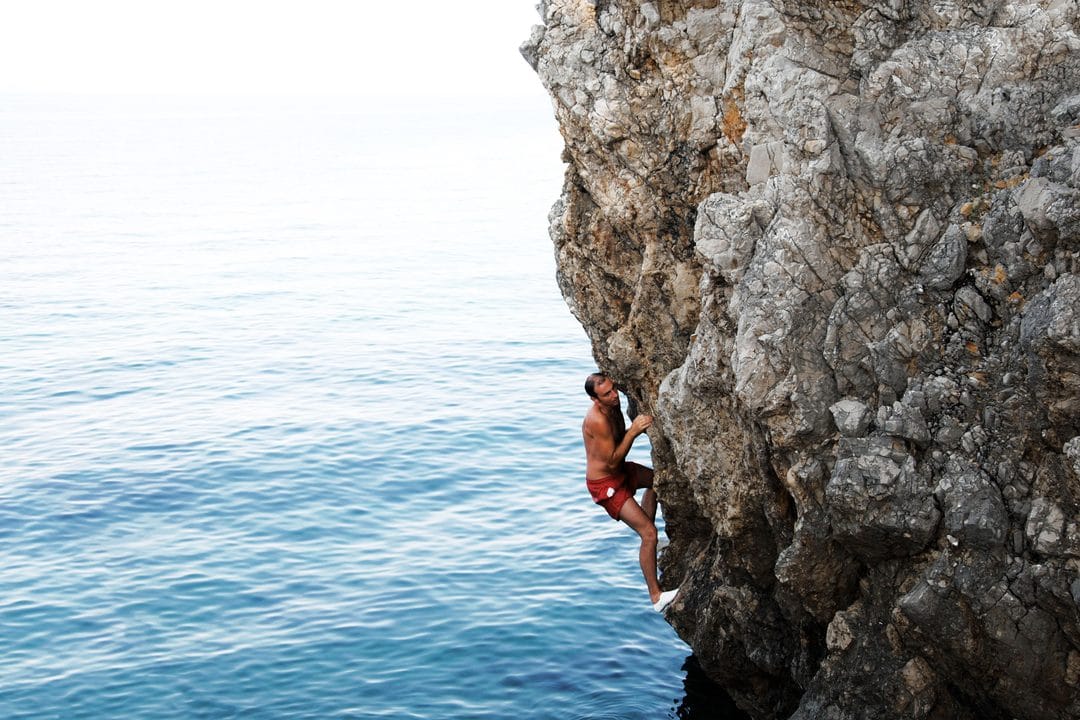
The chalk doesn't work here. That's the first thing that throws climbers who come to deep water soloing from a gym or a granite crag — the holds twenty feet above the Mediterranean are often damp with sea spray, and chalk on wet limestone just turns to paste in your palm. You climb with bare, slightly clammy fingers instead, trusting friction over grip, and the whole time there's a sound underneath you that never stops: water moving against rock, rising and falling with a swell you can't fully predict from the wall.
Deep water soloing — DWS, or psicobloc to the Mallorcan climbers who more or less invented the modern version of it on the island's north coast in the 1970s — is climbing without a rope, without a harness, and without a crash pad, on routes that sit directly above open water. The safety system is the sea itself. That sounds like the most forgiving version of climbing there is, and for the first eight or nine metres of height, it more or less is. Above that, the physics start working against you instead of for you, and the sport stops being a novelty and starts being genuinely dangerous.
What Deep Water Soloing Actually Is
People who've never tried it tend to lump DWS in with bouldering, on the theory that both involve climbing without a rope over a soft landing. That comparison misses the part that matters. A bouldering fall is over in under a second, onto a pad you can see and that doesn't move. A DWS fall off a fifteen-metre route takes close to two seconds of air time, lands you in water that's doing its own thing — surge, chop, a current pulling toward a headland — and then keeps going as you sink several metres before swimming back up. Bouldering ends the moment you hit the pad. A DWS fall is really three separate events: the drop, the entry, and the swim out, and each one can go wrong independently of the other two.
It's also not free soloing with a wet safety net, which is the other comparison people reach for. Free soloists climb routes they've usually rehearsed on a rope until the movement is close to memorised, because a fall anywhere on a free solo is a fall onto rock. DWS climbers deliberately push into terrain they haven't wired, because the entire appeal of the discipline is climbing at your limit with a consequence you can walk away from. That's the real difference: free soloing is about never falling, and DWS is a sport built around the assumption that you will.
The Physics of the Fall
Twelve metres of air feels a lot longer than twelve metres on a rope.
Water is compressible enough to stop you and rigid enough to hurt you, and which one you get depends almost entirely on your body position at the moment of impact, not on how graceful the climbing looked on the way up. Land flat — the classic beginner's "starfish" entry, arms and legs splayed to slow the fall — and you're driving your full body weight against the surface tension of the water at once, which at height translates into bruised ribs, a winded diaphragm, or worse. The technique every serious DWS climber eventually learns is to enter feet-first, body close to vertical, arms tucked in rather than out, and leaning very slightly forward on the way down, because the natural tendency in a feet-first fall from a wall is to arc backward and land flat on your back instead. Get that lean wrong and you find out the hard way that a back-first entry from ten metres feels like landing on a gym mat someone forgot to inflate.
Above roughly ten to twelve metres, most experienced climbers treat every additional metre as a meaningfully higher-stakes decision rather than a linear increase in thrill. Chris Sharma's televised exhibition jumps in the psicobloc competitions of the last decade or so were staged well past twenty metres, with support divers, medical staff and a pool depth engineered specifically for that height — a setup that has almost nothing in common with a Tuesday afternoon session off a sea cliff with two mates and no support boat. That gap between the spectacle version of the sport and the actual practice of it is exactly where most serious injuries happen, because climbers copy the height they've watched on video without any of the infrastructure that made it survivable. A recreational climber falling from that same height has no medical team on a nearby boat and no diver checking the entry point for submerged hazards beforehand, only whatever judgment they brought to the cliff that day. And judgment is exactly what erodes first, since two or three falls into a session your legs stop cooperating the way they did on the first one, even though the height above the water hasn't changed at all. Nobody plans to attempt their biggest fall of the day on tired legs, yet that's precisely what happens when climbers keep pushing for one more line before the light goes.
Depth Is Not Optional — Reading the Tide
The single rule guides repeat most often, and the one climbers ignore most often, is that water depth has to be checked at the state of tide you'll actually be falling into, not the state of tide when you arrived. A cove that reads as comfortably deep at high water can expose a rock ledge or a shallow shelf two hours later, and a fifteen-metre fall onto two metres of water over rock is not a climbing accident anyone walks away from easily. The rough guide most DWS instructors use is that the water beneath a route should be at least as deep as the fall itself, checked against the lowest point of the tide during your session — not a comforting average, the actual low.
- Mallorca's north coast, particularly the routes around Cala Barques and Cova del Diable near Cala Sant Vicenç, remains the sport's spiritual home and the place with the most established local knowledge of which lines are safe at which tide.
- England's south coast around Swanage and the Dorset limestone has a smaller but genuinely active DWS scene, cold water and all.
- The Calanques near Marseille offer some of the most photogenic psicobloc terrain in the Mediterranean, though access has tightened in recent years as French authorities manage overuse in the wider Calanques National Park.
- If you'd rather have a boat idling nearby than pure self-reliance, Thailand's Railay and Tonsai beaches run commercial DWS tours for a reason — warm water, forgiving depth close to shore, and crucially, boats standing by for anyone who swims out of position.
- Halong Bay and Cat Ba Island in Vietnam, among others, have built a smaller tourist DWS industry on the same limestone-and-warm-water formula.
Surge is the variable that trips up climbers who've done their tide homework and nothing else. A swell that looks minor from the clifftop can shove a falling climber sideways into a wall on the way down or drag them against rock on the swim back, and that risk has nothing to do with how deep the water is at any given moment. Check the swell forecast the same way you'd check the tide table, not as an afterthought.
The Gear Paradox
DWS looks like the cheapest form of serious climbing there is — no rope, no rack, no crash pad, no harness — and for a first session that's more or less true. The catch is that the one piece of kit worth actually spending money on is the piece almost every beginner skips, because it doesn't look like real climbing gear: dedicated quick-draining shoes or a pair of genuinely worn-out old climbing shoes you don't mind ruining. Saltwater destroys rubber and stitching within a season regardless of brand, which is exactly why experienced DWS climbers keep a separate, disposable pair for sea cliffs rather than bringing whatever they climbed on that morning at the crag.
Most climbers go in board shorts or a swimsuit, sometimes with a thin rash vest against both sun and rock rash on the approach traverses. A few wear a low-profile buoyancy vest for the swim back to the exit point, especially on longer sessions where fatigue becomes the bigger risk than the climbing itself. Helmets are a genuine point of disagreement in the DWS community — some climbers wear one for the approach scramble and take it off before committing to a route, on the theory that a helmet does nothing for a body traveling feet-first into water and can snag or twist the neck on entry. Others keep it on the whole time regardless. Neither camp is obviously wrong, and the honest answer is that the research on helmet use in vertical water entries specific to this sport simply doesn't exist yet.
Where the Injuries Actually Happen
Ask a longtime DWS climber where people get hurt and the answer is rarely "falling from height." It's the low, casual falls late in a session, from routes barely three or four metres up, taken by climbers who are tired, cold, and no longer paying attention to their entry position because the fall looks trivial. A bad landing from four metres onto a submerged rock at a tide that's dropped further than expected causes more real injuries in this sport than the headline-grabbing big falls ever do. Fatigue also affects judgment before it affects grip — a climber three hours into a session, chilled from repeated dunkings, is far more likely to commit to a move they'd have walked away from fresh, and far less likely to enter the water cleanly if it goes wrong. Cold water speeds all of this up, since even a mild Mediterranean sea in early season pulls heat out of the body faster than most climbers expect, and shivering hands lose precision on wet holds long before anyone consciously feels cold. Add a wetsuit vest for a long session and you buy back an hour of decent decision-making; skip it and you're often climbing your hardest, highest lines exactly when your body is least equipped to handle a bad outcome.
Disorientation after a messy entry is the other injury pattern nobody mentions in the highlight reels. Hit the water off-balance and you can lose which way is up for a second or two — not dangerous in itself in calm water, but genuinely dangerous in surge, current, or anywhere near submerged rock, where a disoriented swimmer can drift into the exact hazard the fall was supposed to clear. Solo sessions without a spotter on the clifftop or a partner already in the water are where this pattern turns serious, because nobody's watching to see that the surfacing swimmer is heading the wrong way.
Getting Started Without Getting Hurt
Start at heights under five metres for your entire first season, full stop — not because the climbing there is easy, but because that's the height range where a bad entry costs you a bruise instead of a fracture, and it's the only way to actually learn your own fall tendencies before the stakes go up. Skip anything marketed as a DWS taster session that doesn't include either a support boat or an experienced local spotter; that margin isn't optional no matter how the price sheet frames it; it's the difference between someone noticing you've drifted off-line and finding out only when you don't come up.
Know your climbing grade on a rope before you take it ropeless over water — DWS is not the place to discover you're stronger than you thought. Build your falling technique deliberately, on purpose, from low height, the same way you'd drill a specific move on a project route: feet first, body vertical, slight forward lean, arms in. And treat the tide table and the swell forecast as part of your rack, checked before every single session, not a box ticked once when you arrived on the coast for the week.