Cliff Diving in 2026: What a 27-Metre Fall Does to a Body, and Why the Entry Matters More Than the Height
Elite divers fall 27 metres in under two and a half seconds and hit the water near 85 km/h — here's the physics, the training path, and the 2026 competition season.
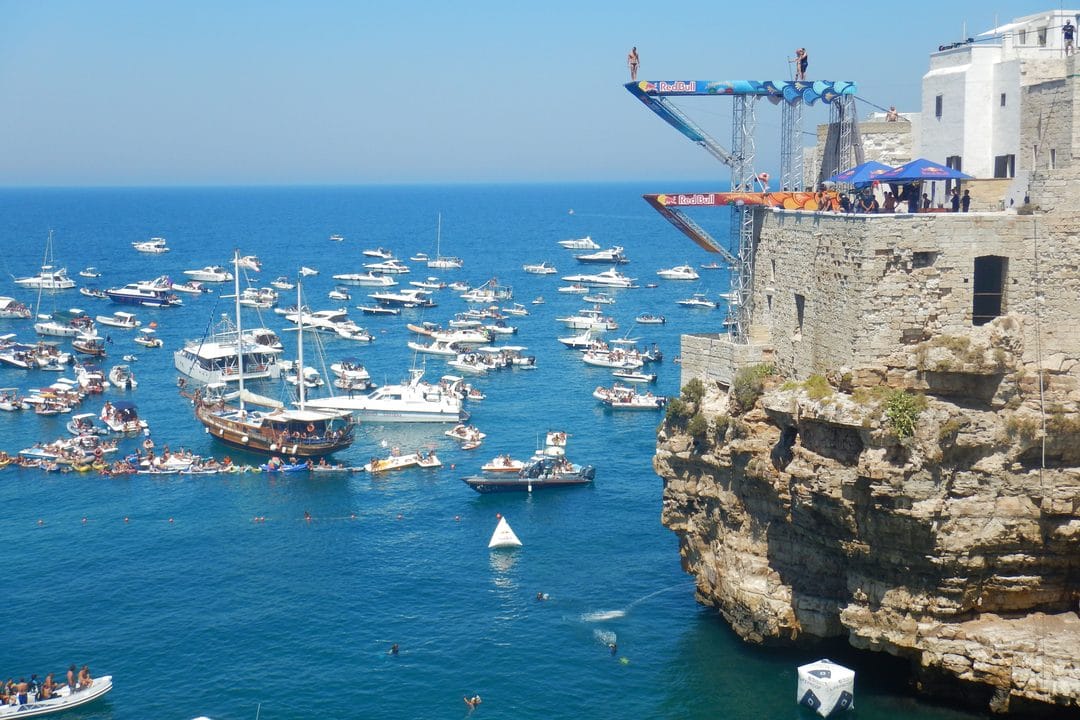
On July 12, 2026, a diver named Aidan Heslop stood on a bare rock platform 27 metres above the turquoise water at Porto Flavia, an abandoned mining site on Sardinia's southwest coast, and threw himself into a forward quad somersault with three and a half twists. The dive carried a degree of difficulty of 6.2 — among the hardest anyone attempts from that height — and it was enough to hold off a near-flawless closing dive from reigning world champion James Lichtenstein, whose signature back quint earned three separate 9.0s but still left him 24.30 points short. Heslop closed out the World Aquatics High Diving World Cup stop on 445.70 points, beating Lichtenstein of the United States by that margin and 2023 world champion Constantin Popovici of Romania by more than 40. What made the win remarkable wasn't just the score. A year earlier, Heslop had been on an operating table having his back reconstructed, the kind of injury that ends careers in most sports built around throwing a human body through open air at speed. He came back, added metres instead of subtracting them, and won anyway — which is the sport in one afternoon: brutal on the body, unforgiving of hesitation, and still somehow the fastest-growing branch of the diving world right now.
"Cliff Diving" Is Actually Three Different Sports
The phrase gets used loosely, and that's a problem, because cliff diving covers at least three activities with almost nothing in common except falling toward water. The version Heslop competes in is high diving, the discipline World Aquatics folded into its official world championship programme back in 2013 and now runs as a fixed-format sport with judged technique, required elements, and a scoring panel that works the same way platform diving does at 10 metres — just from much further up. Red Bull runs a parallel series, the Cliff Diving World Series, which predates the world championship version by several years: the men's competition launched in 2009, the women's in 2014, and it uses natural or semi-natural venues rather than purpose-built pools. Then there's a third category that has nothing to do with sanctioned competition at all — solo jumpers looking for the biggest drop they can find, survive, and film.
That third category produced the outright world record. On August 4, 2015, Swiss-Brazilian athlete Laso Schaller jumped feet-first off Cascata del Salto in Ticino, Switzerland — a 58.8-metre rock face, taller than the Leaning Tower of Pisa — after a team spent weeks surveying the pool below with scuba gear to confirm it was deep enough to survive. He hit the water at more than 123 km/h, just over three and a half seconds after stepping off. It's still the highest cliff jump ever recorded, and Guinness still lists it. What it isn't, by the sport's own definition, is officially a dive: high diving's scoring system requires at least one somersault, and Schaller went in straight and vertical, which means his record-breaking jump doesn't actually count as a competitive dive under the rules the sport he inspired now runs by.
What 27 Metres Actually Does in Two Seconds
Two and a half seconds.
That's roughly the entire flight from a 27-metre platform — less time than it takes to read this sentence aloud, and somewhere inside it a diver has to complete every twist and rotation of the dive. Strip away the twisting and the scoring and what's left is straightforward physics. A body falling freely from 27 metres reaches the water at roughly 85 km/h (53 mph); from the women's height of 20 to 21 metres, it's closer to 73–75 km/h (about 46 mph). Both figures track with what Red Bull's own event material quotes for the series, and they hold up against a basic freefall calculation — gravity does the same arithmetic whether or not anyone's watching.
Speed alone isn't actually the dangerous part — people fall from similar heights in stunt work and diving all the time without injury. What matters is the roughly half-second after the hands touch the surface. A vertical entry, hands stacked one on top of the other, arms locked straight, chin tucked, body rigid from fingertips to toes, punches a narrow channel through the water and lets the diver decelerate over a metre or so of depth rather than stopping dead at the surface. Get the angle wrong by even 10 or 15 degrees and the body meets the water broadside instead of edge-on, and the deceleration happens across a few centimetres instead of a metre — the difference between slicing into water and being slapped by it. Divers and coaches describe a bad entry from 27 metres as being hit by a car, and the injury pattern backs that up: compressed vertebrae, dislocated shoulders, concussions, torn rotator cuffs. Heslop's own back surgery came from exactly this kind of impact, not from the height by itself. It's why the sport spends far more training time drilling entry mechanics than it does the somersaults that actually score the style points.
How Someone Actually Gets to 27 Metres
Nobody starts here. Every diver on that Porto Flavia platform came up through Olympic-style platform diving first — 5 metres, then 7.5, then 10 — years before anyone let them near a height where the wrong entry breaks bones.
- Years of 10-metre platform diving to build the twisting and spatial-awareness skills that translate directly to high diving, almost always starting as a childhood competitive diver rather than picking up the sport as an adult.
- Dryland repetition on trampolines and dry boards with a spotting rig, where a coach can stop a rotation mid-air if the diver loses their spot in the sky — the version of the sport where mistakes cost nothing but pride.
- Foam pits and deep diving tanks used to rehearse entries from progressively greater heights before a single jump happens over open water.
- Height added in roughly one- to two-metre increments across a season, with most divers not attempting the full 20 to 27 metres of official competition until several years into training.
Skip that progression and the sport punishes you fast, which is the single biggest reason nobody serious about this recommends jumping straight into a natural cliff without going through a diving club first. Start at a 10-metre platform with an actual coach watching the entry, not a rope-swing spot a friend found on social media. That's not caution for its own sake; it's the difference between learning to read your own rotation and finding out the hard way, mid-air, that you can't.
Where the Sport Is Actually Happening in 2026
This is a genuinely good year to start paying attention, because the calendar is unusually stacked. The Red Bull Cliff Diving World Series is in its 17th season, running 24 elite athletes — 12 men, 12 women — through stops in Indonesia, the United States, Denmark, Bosnia and Herzegovina, Italy and Oman between May and November, with divers going off platforms as high as 27 metres for men and 21 for women at every stop. The U.S. leg landed in St. Petersburg, Florida in early June, with the platforms built out over the pier itself. Separately, and for the first time, the World Aquatics High Diving World Cup expanded to three stops across three continents this year — Fort Lauderdale in May, Porto Flavia in July, and Zhaoqing, China in November — with a brand-new World Cup Trophy going to the top man and top woman across all three once the China stop wraps up.
The official platforms look like the reckless end of extreme sports. They're actually closer to the safe end. Every World Cup and World Series stop has divers and safety crews in the water surveying depth to the centimetre before competition day one, medical staff stationed on the deck, and a scoring system built specifically to reward controlled entries over showy ones. The real risk in cliff diving sits with the unsanctioned spots — the ones with no survey, no name, and no idea what's sitting six feet under the surface where someone's about to land.
If you actually want to watch this rather than just read about it, go to the source: Red Bull TV and World Aquatics' own streams show the judged detail — camera angles on the entry, replays of the twist count — that a shaky phone clip from a natural cliff spot never will. That's the better way into the sport for anyone curious about it before ever standing on a platform themselves.
The women's field at Porto Flavia produced the tightest finish of the year. Kaylea Arnett of the United States had never won a World Cup stop before her reverse triple pike sailed past Rhiannan Iffland — a five-time world champion who'd started the day in sixth place and still climbed to bronze — and edged Australia's Xantheia Pennisi into silver by 2.40 points after five years of Pennisi chasing her first podium. Heslop now leads the men's World Cup standings on 59 points, Popovici sits second on 55, and the entire season comes down to Zhaoqing in November, where the sport hands out its first-ever World Cup Trophy and somebody's 27-metre season either pays off or doesn't.